Virtual Excellence Through a Systematic Approach: Pusan Cast Iron Adopts the MAGMA APPROACH
Today, the production of safety-critical castings requires a degree of process control that has long become impossible to attain with conventional trial-and-error methods. Defects in the casting process not only have an isolated effect on the quality and operational reliability of the individual component, but also reduce both robustness and cost-effectiveness of the entire process chain. Highly stressed components in particular, such as universal joints, have to comply with extremely demanding requirements for leak-tightness, fatigue strength, and reproducible material properties.
Pusan Cast Iron, Korea, a leading supplier of components for drive and combustion systems, was confronted with severe shrinkage defects during the development of a universal joint. These defects prevented component approval, significantly reduced productivity, and resulted in a considerable increase in manufacturing costs.
Initial Situation: A Critically Unstable Process
Leak tests revealed severe shrinkage defects in a single cavity of the twelve-cavity mold, compromising the structural integrity of the casting. Although the other eleven cavities produced flawless parts, this single defect was enough to call the entire process into question: The effective yield dropped to eleven instead of twelve sound castings per pour – an unacceptable situation for a company that relies on maximum mold utilization. Steady production with eleven cavities was therefore not an option, as this would have fundamentally undermined the economic efficiency of production. Pusan Cast Iron was therefore faced with a classic dilemma: either conducting a costly and time-consuming trial-and-error search for a solution – or adopting a systematic, simulation-based method that virtually maps the problem, identifies its root causes, and leads to the optimal corrective measure.
The MAGMA APPROACH as a Methodological Framework
Instead of relying on the conventional trial-and-error method, Pusan Cast Iron opted for a paradigm shift: a simulation-based optimization strategy with MAGMASOFT® that virtually represents the entire casting process chain – from the liquid metal, to mold filling, up to solidification.
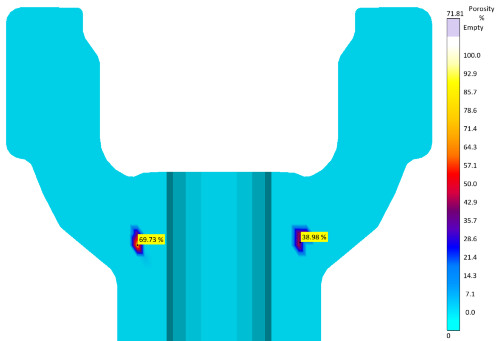
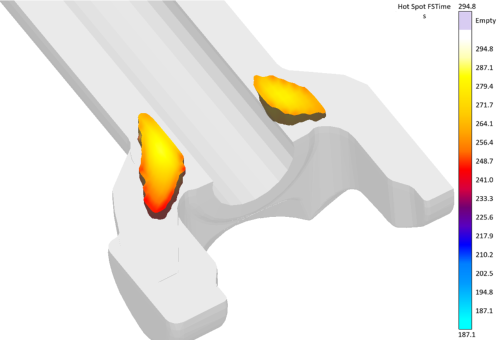
In the first step, the real defects were reproduced virtually. MAGMASOFT® made it possible to precisely locate the shrinkage areas and to uncover their underlying root causes. The 'Fraction Liquid' and 'Hot Spot FSTime' results revealed isolated solidification areas that led to shrinkage porosity due to insufficient feeding (Fig. 2). For the first time, the focus was not only on observing the defects, but also on developing a physical understanding of their formation – the foundation for sustainable optimization.
The MAGMA APPROACH provides the methodological framework: a structured procedure that combines virtual design of experiments with systematic decision-making logic. This methodology is based on six steps: goal definition, defining degrees of freedom, selecting quality criteria, task structuring, selecting an approach, and implementation of results. Each step is directly linked to the problem, and contributes iteratively and efficiently to its solution.
1. Define the Goal: Precision and Efficiency as Key Criteria
The primary goal was clear: to eliminate all shrinkage defects while restoring the original productivity of the twelve-cavity mold. Secondary objectives included reducing scrap and ensuring robust process control in the long term. This step clearly demonstrates that the MAGMA APPROACH requires that problems be defined as concrete, measurable goals rather than left abstract or general.
2. Degrees of Freedom: A Systematically Defined Solution Space
Degrees of freedom are suitable process or geometry parameters that are varied within a design of experiments to reach the defined goals. They determine the number of variants to be examined, possible parameter combinations, and resulting number of designs, and thereby define the scope of the optimization. In MAGMASOFT®, they make it possible to precisely define the solution space for a virtual design of experiments (DoE) and to systematically investigate it through simulation. Thus, they determine the scope of the calculations.
In this specific use case, two process parameters proved to be decisive, as they had a significant effect on both feeding and solidification behavior:
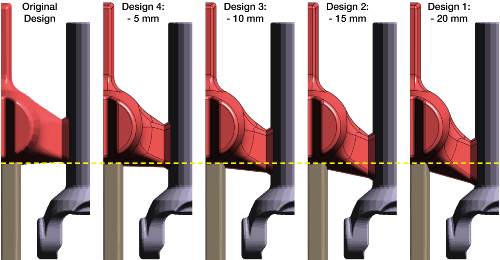
Feeder neck position (variation in 5 mm steps up to 20 mm, see Fig. 3),
Pouring temperature (1,350-1,400 °C in 10 °C steps).
3. Quality Criteria: Measuring & Evaluating
For the evaluation of individual variants in a virtual DoE, quantitative quality criteria are defined. These metrics are the objective basis for both systematically evaluating the process robustness and identifying optimization potential. The combination of these characteristic values enables multidimensional optimization, in which possible goal conflicts, for example, between feeding reliability and thermal loading, can be made visible and balanced against each other. In this way, measurable variables replace subjective assessments with a reproducible, data-driven evaluation.
In this specific use case, the following criteria were used:
Both porosity volume and porosity defect count – for direct quantification of shrinkage defects,
Solidification uniformity – for evaluating the consistent heat dissipation and for preventing isolated hot spots,
Yield – as a productivity-relevant criterion.
4. Task Structuring: Efficiency Through Geometric Reduction
To minimize both time and computing effort without compromising the accuracy of the simulation results, the project complexity was gradually reduced:
First, the critical cavity was isolated using a 'Cutbox', thus reducing the calculation time from 3.5 hours to 1 hour.
In addition, parallel calculations with four cores per variant allowed eight designs to be simulated simultaneously. This full utilization of Pusan's 32-core license reduced the actual calculation time to 24 minutes per variant.
Overall, this approach led to an 86 % increase in efficiency. At the same time, focusing on the critical cavity allowed a targeted analysis of the physical mechanisms responsible for the defects – without unnecessarily investing computing resources in non-critical areas. This created the basis for carrying out a comprehensive and reliable design of experiments in a reasonable amount of time.
5. Approach: DoE, Parallel Coordinates, Main Effects
An adequate process window was determined using a full-factorial design of experiments covering all 30 combinations of feeder neck position and pouring temperature. Two central tools were used to evaluate the results:
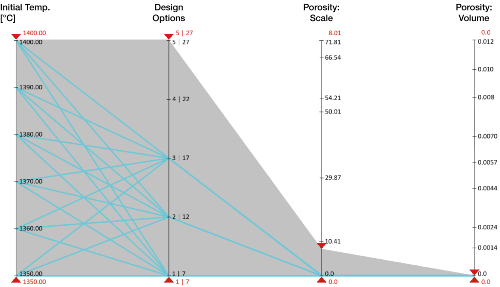
The parallel coordinate diagram (fig. 4), to both visualize the dependencies between degrees of freedom and quality criteria and enable the identification of robust parameter combinations.
The main effects matrix, to both quantify the influence of individual degrees of freedom on the quality metrics and allow a reliable evaluation of the individual sensitivities.
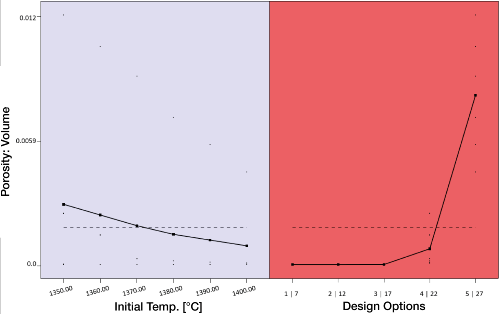
The evaluation of the DoE provided clear results: Shifting the feeder neck by 15 mm (design 2) reduced shrinkage defects to an acceptable level. Although a shift by 20 mm (design 1) also ensured reliable feeding, it significantly increased the geometric mold complexity, making implementation economically unfeasible. A 10 mm shift (design 3), however, could not guarantee reliable feeding in all cases; therefore, this variant was excluded.
In contrast, variations in pouring temperature showed negligible effects (Fig. 5): Variations between 1,350 °C and 1,400 °C showed only marginal differences (< 2 % effect on the shrinkage volume). This confirmed that the original temperature of 1,370 °C was appropriate and ensured process stability.
The optimal corrective measure was therefore a 15 mm shift of the feeder neck position at an unchanged pouring temperature of 1370 °C – a solution that ensured both technical robustness and economic efficiency.
The strength of this methodology lies in the systematic analysis of all parameter combinations rather than isolated trials. This prevents seemingly "random" improvements from obscuring the root causes of defects and instead enables the development of reliable, reproducible solutions.
6. Implementation and Validation: From Simulation to Series Production
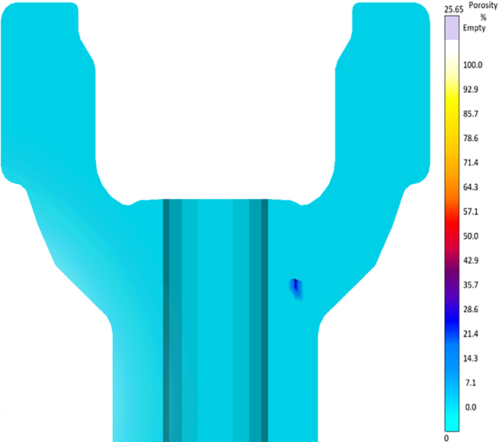
Based on the results from the virtual design of experiments, the geometry of the twelve-cavity mold was modified to accommodate the optimized feeder neck position. The subsequent validation in series production clearly confirmed the simulation predictions (Fig. 6): Porosity was reduced to an acceptable level, thus allowing a reliable and flawless pouring of the twelve-cavity mold, increasing productivity by 9 %, and reducing the scrap rate to zero.
The result illustrates the added value of a methodical, simulation-based approach: Systematic analysis and targeted implementation allowed finding a sustainable solution to a clearly defined problem.
Conclusion: A Step-by-Step Approach as a Competitive Edge
The project at Pusan Cast Iron is an example of how the MAGMA APPROACH bridges the gap between virtual forecasting and industrial reality. By precisely combining goal definition, selected degrees of freedom, measurable quality criteria, efficient task structuring, methodical design of experiments, and consistent implementation, it was possible not only to accelerate development processes, but also to raise process quality to a new level, while establishing a robust series production right from the start.
Pusan Cast Iron transformed an acute production problem into a methodically founded success story – and demonstrates that excellence is not a matter of chance, but the result of stringency, systematic methodology, and the consistent application of modern simulation technology.